How is that possible? The (fake) proof that 1 + 1 = 4
Since kindergarten, we have all shared one unshakable certainty: 1 + 1 = 2. It is the very foundation of our logic and of basic mathematics.
But what would you think if I told you that, using seemingly flawless algebraic steps, I can prove to you that 1 + 1 = 4?
Get ready to be "tricked" by your own brain. Here is the proof, step by step. Find the mistake!
The fake proof
Let's start from a trivial and undeniable equality:
−3 = −3
Now let's rewrite the number −3 in two different ways, one on each side. On the left we write it as (1 − 4) and on the right as (9 − 12). Both operations really do give −3, so the equality still holds:
1 − 4 = 9 − 12
Now let's add the number 4 to both sides of the equation (a perfectly legal move in algebra):
1 − 4 + 4 = 9 − 12 + 4
Look closely at these numbers. We can rewrite them to highlight the squares. For example, 1 is the square of 1 (12), and 4 is the square of 2 (22). On the right, 9 is the square of 3 (32). So we can read both sides as the expansion of a "squared binomial":
12 − 2(1)(2) + 22 = 32 − 2(3)(2) + 22
Rewriting each side as the famous squared binomial, we get:
(1 − 2)2 = (3 − 2)2
So far, so good. Now it's time to "clean up" the equation. How do you get rid of a square? Easy: take the square root of both sides!
√((1 − 2)2) = √((3 − 2)2)
The squares and the roots cancel each other out, leaving us with:
1 − 2 = 3 − 2
At this point, let's add 2 to both sides (or, if you prefer, cancel the −2 that appears on both the right and the left). We are left with:
1 = 3
We're almost there! Now we just need to add 1 to both sides, and here comes the final twist:
1 + 1 = 4
Revealing the trick: where is the mistake?
If you are now doubting everything you were taught at school, take a deep breath. The universe still makes sense, and 1 + 1 is still 2. But where did I fool you?
The deception is hidden in this precise step:
√((1 − 2)2) = √((3 − 2)2)
which we cheerfully simplified to:
1 − 2 = 3 − 2
At school we are often taught that "the root and the square cancel out", but a fundamental detail gets left out: the square root of a squared number always gives back the absolute value of that number, not the bare number itself!
In mathematical language, we write it like this: √(x2) = |x|
Let's see what happens if we apply the correct rule. On one side we have (1 − 2), which is −1. On the other side we have (3 − 2), which is 1. If we square them, in both cases we get 1. And the square root of 1 is, of course, 1.
So the correct step would have been:
|−1| = |1|
That is: 1 = 1. An incredibly boring equality, but a true one!
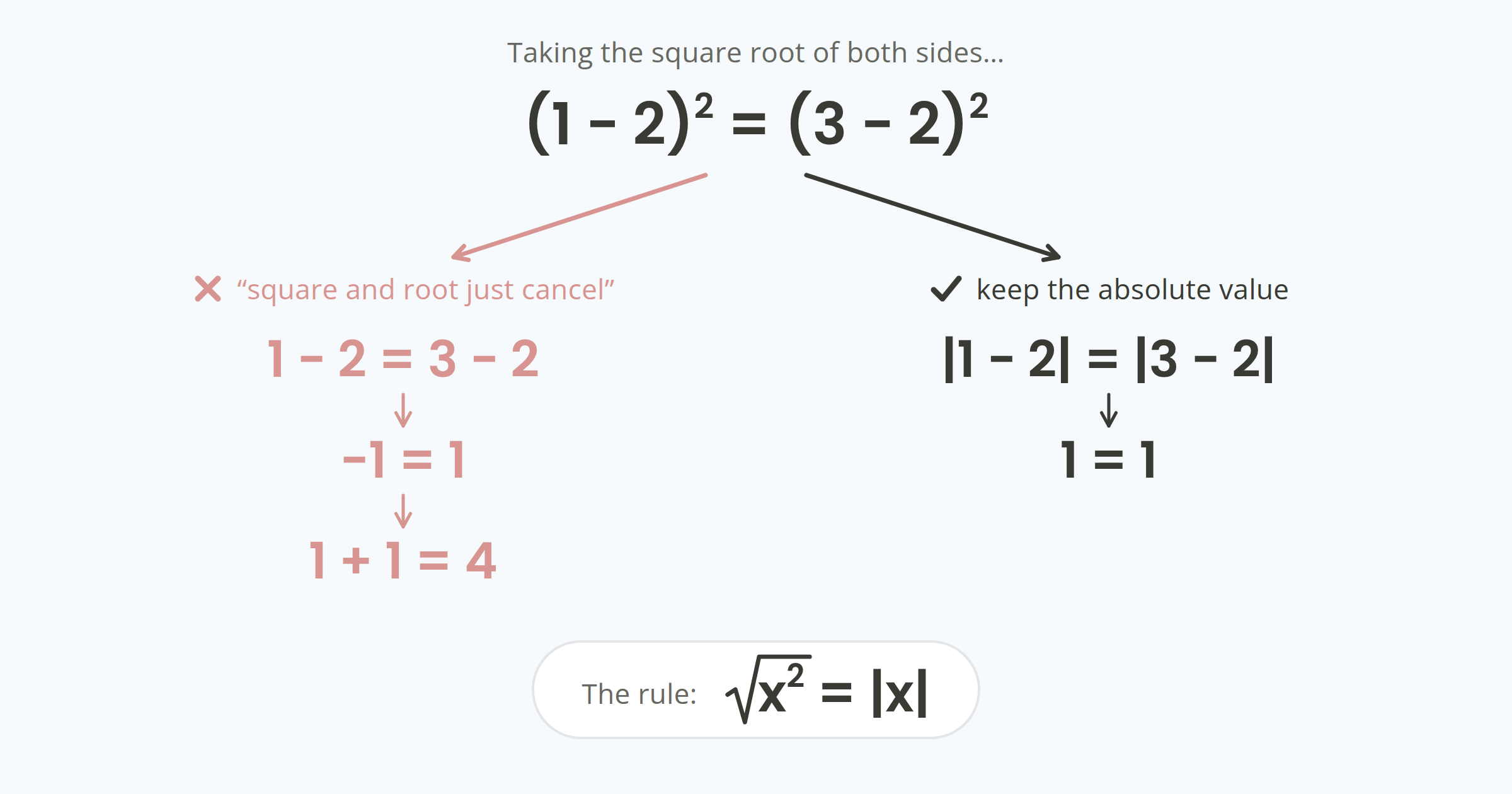
By dropping the absolute value bars, we illegally equated a negative number (−1) with a positive number (1), setting off the domino effect that led us to the crazy result 1 + 1 = 4.
Conclusion
Mathematics is a wonderfully precise language. When we try to take shortcuts and forget the fundamental rules (like the importance of the absolute value), numbers are always ready to set a trap for us and have a laugh at our expense!

Social links